Research
We explore the physics of soft and disordered matter through statistical mechanics and computational modeling, spanning systems from polymer networks and colloidal assemblies to multivalent biomolecular interactions.
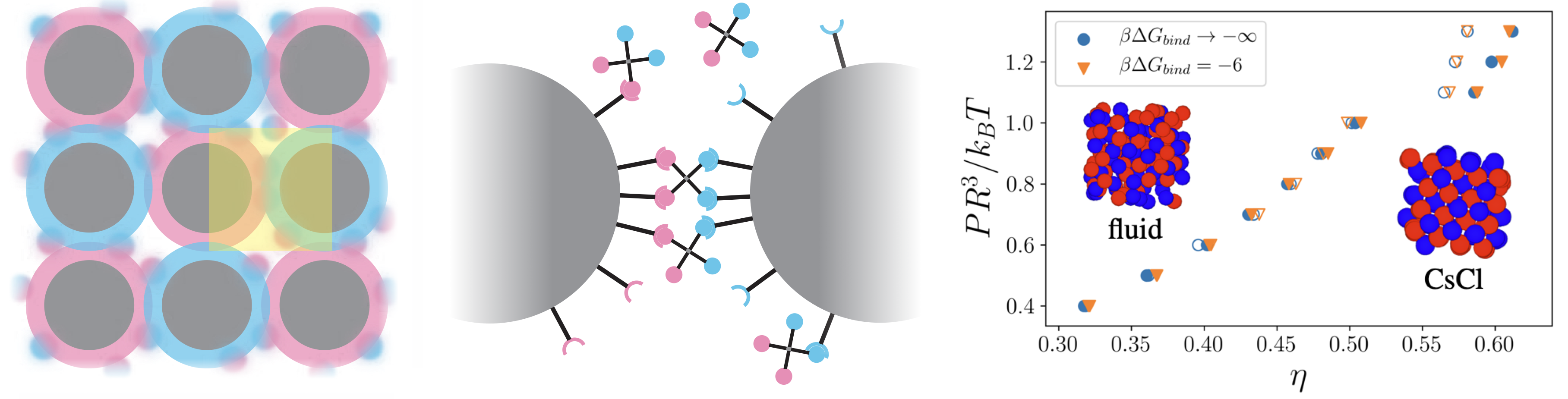
DNA Programmable Self-Assembly
Programmable self-assembly offers a uniquely powerful way to build complex materials from simple components, but conventional DNA-based designs often become overly intricate and kinetically fragile. Our work shows how free DNA linkers can streamline interactions, widen the practical assembly window, and reveal unexpected organizing principles rooted in multivalent binding, providing a clean and versatile framework for reliably forming complex structures in both experiments and theory.
- X. Xia, Y. Peng, K. K. Li, and R. Ni, Reports on Progress in Physics 88, 078101 (2025)
- X. Xia, H. Hu, M. P. Ciamarra, and R. Ni, Science Advances 6, eaaz6921 (2020)

Superselectivity from Multivalency
How can weak multivalent interactions yield “superselective” binding? We use statistical mechanics to capture the cooperative nature of multivalent binding, quantify how ligand density, receptor distribution, and affinity tune thresholds and sensitivity, and explore how these principles enable robust targeting and detection.
- X. Xia, R. Ni, Phys. Rev. Lett., 132, 118202 (2024)
- X. Xia, G. Zhang, Y. Jiao, R. Ni, JACS Au 3, 1385 (2023)
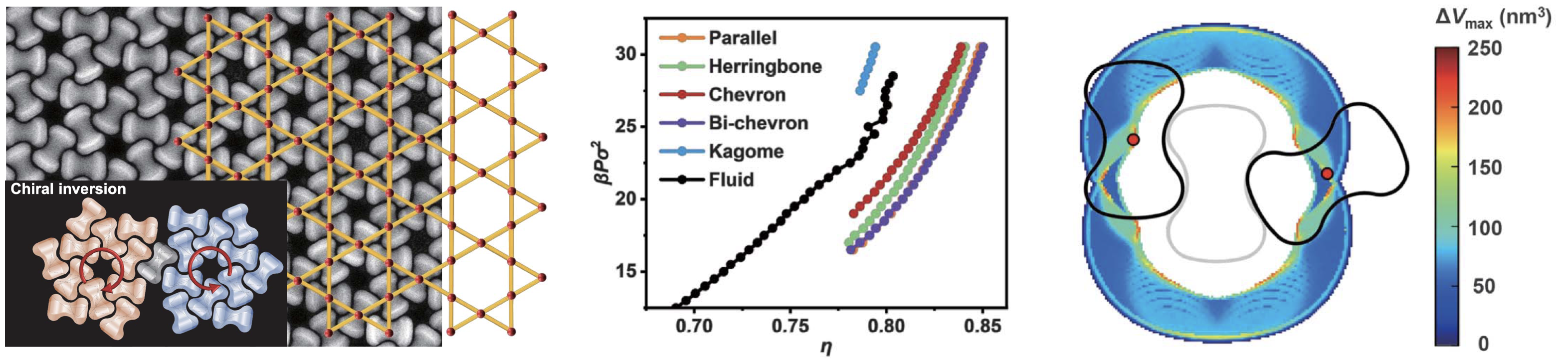
Complex Colloidal Self-Assembly
Complex colloidal systems can spontaneously organize into a remarkable variety of structures, yet achieving controlled assembly of open, hierarchical, or mixed-dimensional architectures has remained challenging due to geometric frustration and kinetic bottlenecks. Our work shows how particle shape, curvature, and multivalent entropic interactions together create robust pathways for order to emerge, enabling large-scale organization beyond close-packed crystals. These principles unify our studies across nanoparticle superlattices, hybrid dimensions, and anisotropic colloids, offering a versatile foundation for designing materials with rich optical, mechanical, and topological functionalities.
- S. Wan, X. Xia, Y. Gao, H. Zhang, Z. Zhang, F. Wu, X. Wu, D. Yang, T. Li, J. Li, R. Ni, A. Dong et al., Science 387, 978 (2025)
- T. Li, X. Xia, R. Ni, A. Dong et al., Sci. Adv. 8, eabq0969 (2022)

Vitrimer Physics
Vitrimers are reconfigurable polymer networks with dynamic bond exchange. We study how bond-swap kinetics, network architecture, and thermal history govern their rheology and relaxation, and how these levers can be used to design adaptable, recyclable soft materials.
- P. Rao, X. Xia, R. Ni, J. Chem. Phys., 160, 061102 (2024)
- X. Xia, P. Rao, R. Ni, JACS Au 2, 2359 (2022)
- Q. Lei, X. Xia, R. Ni et al., PNAS 117, 27111 (2020)